
Connecting Sensors to AnyMaint: From Real-World Equipment Data to Real-Time Insights
In equipment-intensive industrial environments, the physical sensors installed on machines are among the most accurate and valuable sources of information about equipment condition.
AnyMaint connects this data directly to the platform and transforms it into real-time insights, failure predictions, and AI-powered maintenance recommendations.
Why Connect Sensors to AnyMaint?
Connecting sensors to maintenance software provides a complete, real-time view of machine condition and enables maintenance to be managed more intelligently, accurately, and cost-effectively:
-
Early fault detection - identify anomalies before they turn into downtime.
-
Predictive maintenance - use sensor data, historical failures, and wear patterns to generate accurate maintenance predictions.
-
Reduced downtime and costs - address issues proactively and effectively in real time.
-
Full real-time visibility - instant alerts and mobile updates keep teams informed.
-
Improved quality - continuous monitoring of critical production parameters.
More Than Sensor Data
AnyMaint connects sensor readings with the equipment’s maintenance history, technician reports, work orders, operating conditions, and other relevant information. This provides the context needed to understand not only that something has changed, but also what it may mean and what should happen next.
The platform supports maintenance teams with AI-powered analysis and recommended actions, while the final decision remains with the people who understand the equipment and operating environment best.
How Does AnyMaint Connect to Industrial Sensors?
AnyMaint connects to OT and IIoT sensors through industrial systems and interfaces such as SCADA, PLC systems, and REST APIs..
The platform collects real-time data such as vibration, temperature, noise, and motor current. It then normalizes and analyzes this data, turning it into AI-powered predictions and clear maintenance recommendations.
AnyMaint can connect to both existing and newly installed sensors, without requiring infrastructure replacement or a complex IT project.

How AnyMaint Turns Sensor Data into Actionable Insights
AnyMaint connects to a wide range of sensors and existing infrastructures, making the implementation process fast and efficient.
1. Connection to the Plant’s OT Layer
AnyMaint can receive equipment data through a range of existing industrial systems and data sources, including:
-
REST APIs
-
SCADA and PLC systems
-
Wireless sensors
There’s no need to replace existing equipment - AnyMaint connects to your current infrastructure or to any new sensors you choose to add.
2. Real-time Data Collection
The system can pull data from hundreds of sensors and create a continuous, real-time picture of machine condition, including:
-
Vibrations
-
Temperature
-
Noise levels
-
Motor currents
-
Pressure and flow rates
-
Operating hours and wear
The data is automatically collected, normalized, and analyzed — without requiring human intervention.
3. Advanced AI Analysis
Beyond standard connectivity capabilities, AnyMaint uses AI tools to strengthen the insights generated from sensor data. AI enables the system to:
-
Detect abnormal patterns
-
Track fluctuations over time
-
Assess wear and edge conditions
-
Predict the probability of failures
-
Recommend maintenance actions such as inspections, lubrication, part replacement, or planned shutdowns
Get Smart Alerts Before Problems Escalate
Instead of simply adding more data, AnyMaint delivers information that supports action:
-
Threshold-based alerts
-
Trend and anomaly detection
-
Data-drift notifications
-
Automatic work-order creation
-
Real-time updates to technicians’ mobile devices
Every alert includes a clear explanation — what happened and what action is recommended next.
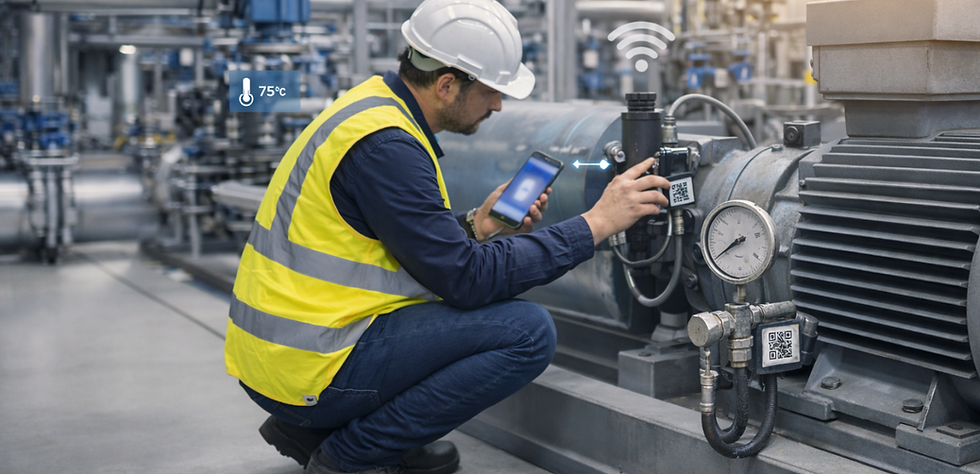
Live Insights from the Production Floor and Field Sites
AI-Powered Maintenance Support
-
Proactive, condition-based maintenance supported by AI
-
A connected maintenance workforce
-
Data-driven decision-making
-
Preservation of operational knowledge
Rapid Implementation — Even in Complex Environments
With AnyMaint, you can start small and scale gradually:
-
Connect one or two sensors as a POC
-
Expand to entire production lines
-
Integrate both existing and new sensors
There’s no need for a long IT project — we handle the heavy lifting.
Frequently asked questions
- 01
- 02
- 03
- 04
- 05
- 06
Want to see how AI can connect sites, teams, and data?
Book a demo and meet the co-pilot your team deserves.





All Rights Reserved to AnyMaint - 2026
